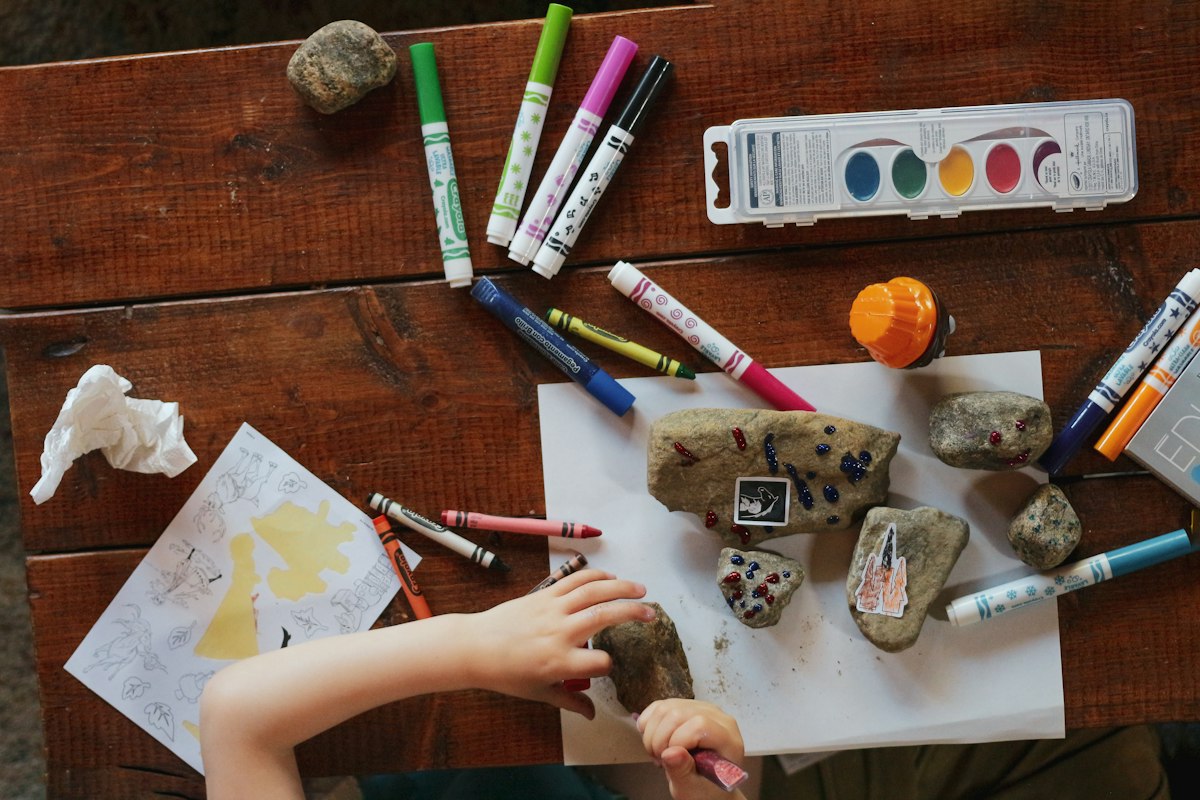
Bad drawings are the point. These twelve games run on paper, markers, and a countdown, and every one of them rewards a fast guess or a weird idea over clean linework. Choose by group size, then keep the rounds short.
Drawing games are about laughs not talent
Set the scoring so nobody is rewarded for shading. Points go to the guesser, the team, or the whole table — never to the prettiest sketch. A few house rules handle the rest:
- Thick markers, small paper. Detail becomes impossible, so nobody attempts it.
- No letters, numbers, or arrows.
- Everyone draws at once wherever the format allows; waiting is what makes people self-conscious.
- End the round before the argument about whether that's a horse.
Draw-and-guess games
Write prompts on index cards before people arrive, the same way you'd prep DIY card games, so the host isn't inventing words under pressure.
- Sticky-Note Teams. Two teams; one drawer sketches a secret prompt while teammates shout guesses, and a correct guess scores for both sides. Easy for classrooms where players rotate in and out. Typically 6–12 players, school-age and up, indoors at a table, roughly 2 minutes of setup, sticky notes and markers.
- Blind Contour Clues. The drawer studies a real object — a shoe, a mug, a houseplant — and never looks down at the paper, drawing it in one slow line. Guessers name the object. Typically 3–8 players, ages 8 and up as a starting point, indoors with the object on a central table, near-zero setup.
- Squiggle Starters. One person scribbles a random loop; the next must turn it into something recognizable, and the group guesses what it became. A reliable icebreaker for adults who insist they can't draw. Typically 4–10 players, teens and adults, indoors at any flat surface, seconds of setup.
- Close-Up Guessing. Enlarge one tiny piece of a familiar thing — a keyboard corner, a pizza crust edge — until it fills the page. First correct guess draws next. Typically 4–8 players, older kids and adults, indoors at a table, about a minute of prep.
Pass-the-drawing games
Collaboration lowers the stakes: nobody owns the whole picture, so nobody feels judged.
- Sketch Telephone. Everyone draws a prompt, passes left, then redraws whatever arrives, with no words anywhere in the chain. Compare first and last sheets out loud. Typically 5–10 players, ages 8 and up, indoors seated in a circle, one sheet and marker per person.
- Pass the Portrait. Start a face, then pass on a timer (30 seconds works as a starting point); each new holder adds one feature. Portraits return to their owners gloriously wrong. Typically 4–12 players, mixed ages, indoors at a table, no prep beyond paper.
- One-Scene Mural. Tape down a long sheet and give the table one setting, such as a busy kitchen. Each player adds a single element, then hands off. Typically 4–10 players, indoors with wall or floor space; outdoors, use chalk on dry pavement, since wet pavement gets slick.
- Finish My Doodle. Sketch any shape briefly, swap with a partner, and complete theirs into something recognizable. Partners guess the original intent before it's revealed. Typically pairs, 4–20 players total, ages 7 and up as a starting point, indoors, no setup.
Timed sketch challenges
If your group enjoys countdown pressure, the structure behind DIY challenge games transfers straight to paper.
- Ten-Second Dash. Call a word, count down from ten, pens down. Sheets go up together and the table votes for the most readable one, not the best. Typically 4–12 players, school-age and up, indoors at a table, no prep.
- Wrong-Hand Round. Same drill, non-dominant hand only, no switching mid-round. Mixed-skill groups level out immediately. Typically 4–12 players, ages 8 and up, indoors, no setup, plenty of table room for elbows.
- Shapes-Only Sprint. Draw the prompt using nothing but circles and straight lines, ruler-free, with a one-minute limit as a starting point. Guessers call out answers as they spot them. Typically 4–10 players, older kids and adults, indoors, no prep.
- Team Mural Race. Two teams, two taped-up sheets, one theme; each member adds one item, then tags the next player. Keep it to walking speed — markers, hard floors, and rushing don't mix. Typically 6–16 players, indoors with open floor space, a few minutes of taping.
Making drawing games work for mixed ages
Match the prompt to the youngest reader, then adjust who holds the marker. Pre-written prompt lists from paper games save you from improvising mid-round.
| Group mix | Adjustment |
| --- | --- |
| Young kids with adults | Adults draw, kids guess; hand over the marker whenever a child asks |
| Wide age spread | Prompts everyone knows: animals, food, household objects |
| Teens and adults | Abstract prompts like "Monday" or "jealousy," tighter timers |
Supervise young children closely: marker caps are a choking hazard for kids under three. If players cut their own sheets, keep scissors at a seated table and pass them handle-first. Store finished drawings face-up in one pile — the reveal at the end is usually the best part of the night.