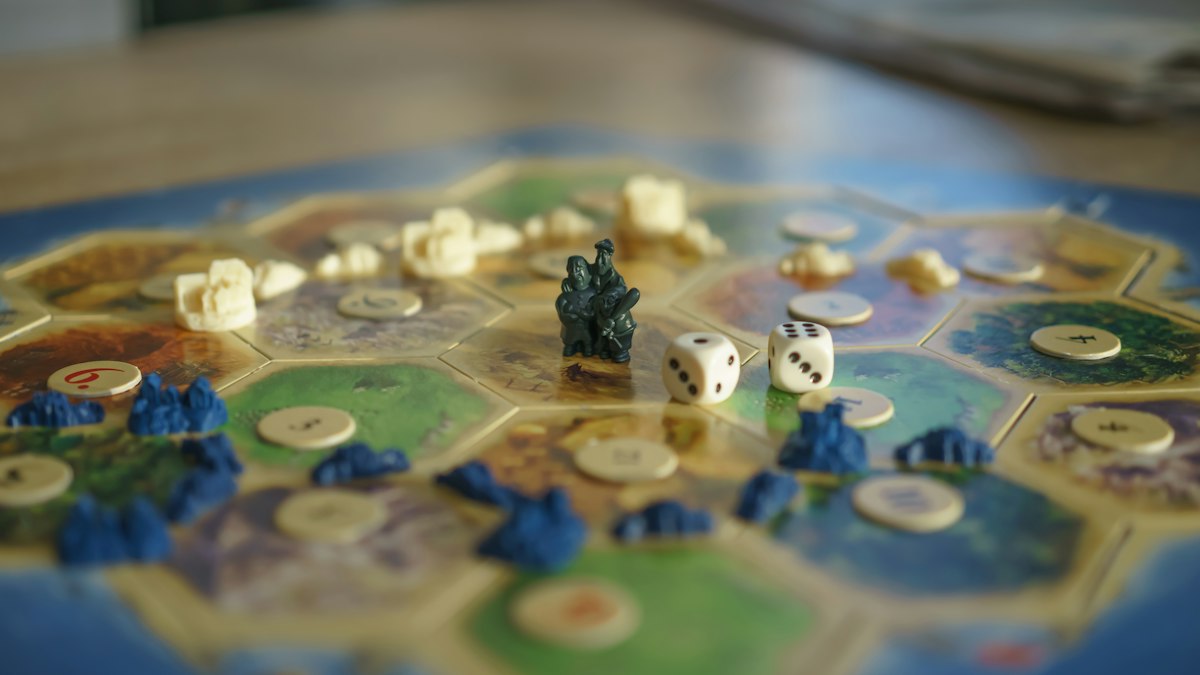
A board game needs a surface showing where pieces can sit, pieces to move, and a rule for who moves next. All ten below come from paper, markers, and small things already in your kitchen drawer.
What makes a board game a board game
Making the board and designing the rules are separate jobs. The board is craft: draw spaces, connect them, mark a start and a finish. The rules are engineering: how far a piece moves, what happens where it lands, how someone wins. Draw first, attach one movement rule and one win condition, then test a round before adding anything clever.
| Job | Household stand-in |
| --- | --- |
| Tokens | Buttons, dried beans, coins, bread tags |
| Randomizer | Numbered slips in a cup, or a pencil spun through a paper clip |
| Board backing | Cereal-box cardboard, clipped down outdoors so wind doesn't scatter it |
Small tokens are a choking hazard for children under three; supervise closely, and let adults cut paper squares as substitutes. Groups who would rather write than move pieces can stick with paper games.
Draw-your-own board games
One marker, one sheet. Redraw the board whenever a rule changes.
- Room Map Fetch. Sketch your rooms as boxes joined by doorways, a paper chip in each. Move a button through the doors collecting chips; first to hold one from every room wins. Teachers can redraw it as a classroom map. Typically 2–4 players who can count spaces, about 10 minutes to draw, indoors at a table.
- Washed-Out Bridges. Six islands, linked by drawn bridges. Draw a numbered slip, move that many bridges, then erase one bridge for good. First to the far island wins; stranded players restart at the nearest one. One sheet, coins for tokens; typically 2–4 players, about 10 minutes, indoors. The shrinking map gets mixed ages talking.
- Color Zones. Four wobbly colored regions fill the page, each holding a few spaces. Spin a pencil to pick your next color; land on an occupied space and you swap. First to visit all four colors wins. Good for players who know their colors — typically 2–3, indoors, about five minutes.
- Spiral Countdown. Number a spiral of about 30 spaces from the outside in. Move inward by the slip you draw; overshoot the center and you drop back five. Early counters manage fine with an adult reading slips. One sheet, any table; for example 2–4 players, five minutes of drawing.
Print-and-play style games
Here "printing" means copying: draw a master sheet, then trace it so everyone holds the same board.
- Route Sheet. Everyone gets an identical grid with a start, a finish, and a few walls. Draw two slips, choose one, mark that many steps in any direction; first to the finish wins. Pencils only, desk-sized; typically 2–6 players, about 10 minutes of copying — quiet enough for classrooms.
- Symbol Boards. Trace a 3-by-3 grid and fill it with nine simple symbols in any order. A caller pulls symbol slips from a cup; cover matches with beans, first full board wins. One sheet per player, indoors; typically 3–8 players, roughly 10 minutes. Cheap to scale for event tables.
- Fork Sheet. One shared path splits three times before the finish. Shortcut branches cost beans to enter; the long way is free but slower. Pencil your initials to track position; first to the finish wins. One sheet, indoors; around 2–4 players, five minutes of drawing.
Race and chase games
Movement is the point, so keep tracks short and turns quick.
- Two-Lane Sprint. Two parallel lanes of about 20 spaces, plus one shortcut that skips five — but drawing a 1 sends you back to start. Draw a slip each turn and move. Indoors, one sheet; a starting point is 2–4 players and 10 minutes of drawing.
- Fox and Hare. On a drawn loop, the hare moves by the slip drawn while the fox always moves two. When the fox lands on the hare, roles swap. Built for two, with rotation at parties; one sheet, two buttons, table space, a few minutes of drawing.
- Closing Ring. Three concentric rings, everyone racing inward. After each full round, cross off the outer ring; anyone still there is out. First to the center wins, and elimination keeps rounds short for mixed groups. Indoors, one sheet; for example 3–6 players, about 10 minutes.
Designing simple rules that work
- Write the turn as three verbs — draw, move, resolve — so anyone can repeat it back.
- One movement rule, one win condition; add a third only after a test game.
- Keep turns near 30 seconds as a starting point; long turns lose the room.
- Give the last-place player a small edge, for example two slips and a choice.
- Settle ties up front: shared win or one extra turn.
- Test with a pencil in the margin, and cut any rule you explain twice. Groups wanting deeper decisions can try DIY strategy games.