Sixteen players is where turn-by-turn games fall apart. These fifteen keep the whole crowd busy at once, using paper, cups, chairs, and a jar from your kitchen — nothing bought per person.
What scales and what does not
Games scale when everyone acts at once: parallel teams, room-wide votes, circles where nobody stops watching. They collapse when players queue for individual turns or when elimination strands half the room on the sidelines.
Five or six per team is a useful starting point — everyone gets a job, and a quiet player can contribute without performing solo. For example, 24 splits into four teams of six; 36 into six teams of six. Past 50, run heats instead of one giant bracket. Counts and setup times below are starting points, not limits. If your headcount falls under 16, the 9–15 player games or 5–8 player games fit better.
Large-group energizers
- Count to Twenty — Everyone counts up from one in no set order; two voices at once means starting over. 16+, anyone who can count, indoors, no setup or materials, a quiet circle. Settles a loud room fast.
- Pass the Clap — A clap travels the circle; a double clap reverses it, and fumbles simply restart the rhythm. 16+, kids who can follow a visual cue and up, indoors or calm outdoors, no setup, standing circle. Nobody waits for a turn.
- Silent Line-Up — Without talking, the group sorts into one line by birth month, then reads the line aloud to check. 16+, kids who know their birthday, indoors or out, no setup or materials, a long open strip. Breaks up arrival cliques.
- Fruit Basket Switch — Chairs in a circle, one fewer than players; the caller names a trait and everyone matching swaps seats. 16+, capped by your chair count, quick listeners, indoors, a few minutes of chair setup. Walking only — no diving for seats, and fingers clear of chair frames.
Team competitions at scale
- Paper Tower — Teams build the tallest freestanding newspaper tower using one shared tape roll; measure at the buzzer. Teams of five or six, 16+, readers and up, indoors, roughly five minutes of setup, floor space per team. Tear paper rather than passing scissors around.
- Over-Under Relay — Lines pass a soft ball overhead, then between legs, alternating; first team to return it to the front wins. Teams of six, 16+, movers, indoors or dry grass, one ball and a clear lane per team. Walking pace, no lunging.
- Human Spell-Off — Teams holding hand-lettered cards arrange their bodies to spell a called word before the others do. 16+, confident spellers, indoors or out, about ten minutes to letter cards, open floor per team. Reuse the cards all event.
- Paper Plane Range — Teams fold scrap-paper planes and throw for distance; each team's best three throws count. Teams of four to six, 16+, folders, long hallway or field, a few minutes of setup, one clear lane. Nobody stands downrange.
- Category Chain — Two minutes, one pen per team: list as many items in a category as possible, passing the sheet along. 16+, writers, indoors, paper only, seated clusters. The quiet reset between loud rounds.
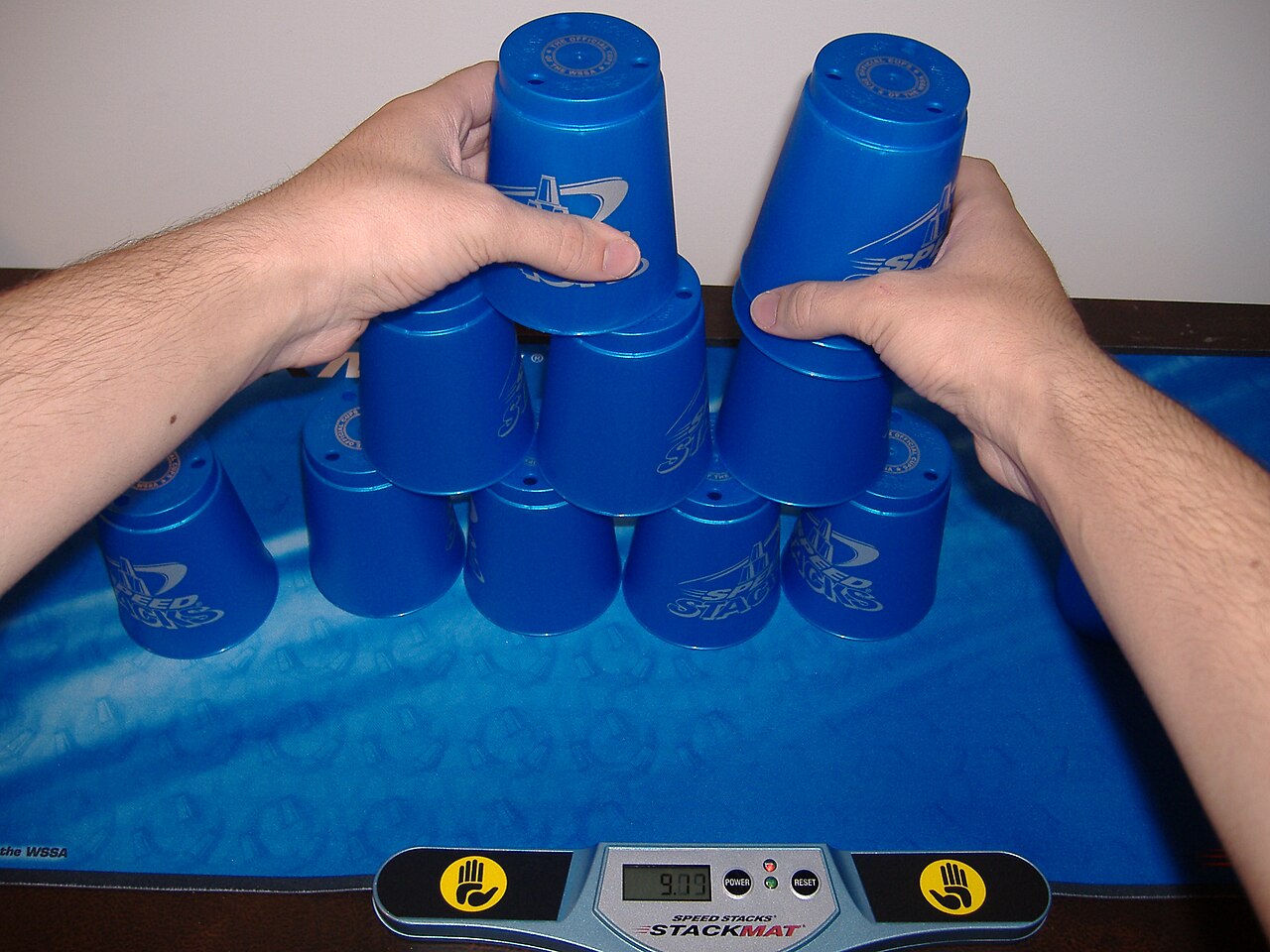
- Cup Pyramid Race — Teams stack plastic cups into a pyramid, then collapse them into one stack; fastest clean build wins. Teams of four to six, 16+, steady hands, indoors, one flat table and cup set per team.
Whole-group guessing and voting games
- Team Two Truths — Each team submits three statements about itself, one false; the room votes by raised hands. 16+, readers, indoors, no setup or materials, seats facing one host. Shy players contribute through their team.
- Vote with Your Feet — The host reads a this-or-that and players walk to the matching side of the room; a few explain their pick. 16+, mobile players, indoors or fenced outdoors, no setup, wide floor. Walking only, no crowding the dividing line.
- Who Wrote It? — Everyone writes one odd true fact on a slip torn from a shared sheet; the host reads them out and the group points at the likely author. 16+, writers, indoors, a few shared pens, seated circle. Keep facts voluntary.
- Fishbowl Charades — Teams draw from one shared bowl of slips and mime for their own team against a timer. Four to eight teams, 16+, readers, indoors, a few minutes writing slips, one clear performing spot. Rotate mimers so nobody sits out.
- Estimation Jar — Teams confer and submit a single guess for the dried beans in a jar; closest wins. 16+, number-sense and up, indoors, a few minutes of setup, one jar plus paper per team. Keep it sealed — loose beans are a choking hazard, and toddlers nearby need adult supervision.
Running it smoothly: space, sound, timing
Stand where the back row can see you, give one instruction at a time, and demo a single round instead of explaining three. Without a sound system, use a visual stop signal — you raise a hand, everyone raises theirs and goes quiet — and let team captains relay rules to their own huddle.
Clear a rectangle before you start; chairs and tape mark boundaries. Outdoors, check for holes and wet patches, and skip paper games in wind. Keep rounds to roughly three to five minutes and announce scoring before play, not after. Odd leftovers can run a 3–4 player game at a side table.